Animal Welfare in Grooming: Beyond the Pretty Words
Everyone talks about animal welfare. Our clients ask for it, training programs sell it, and social media is full of it. But the real question — the one we rarely ask — is this: are we all talking about the same thing?
The short answer? Not really.
I’m writing this article for grooming professionals, instructors, students, and pet owners who want to understand what really hides behind the word welfare — not just in the glossy brochures.
The Pet Wellness Boom: Beautiful Trend, Big Challenge
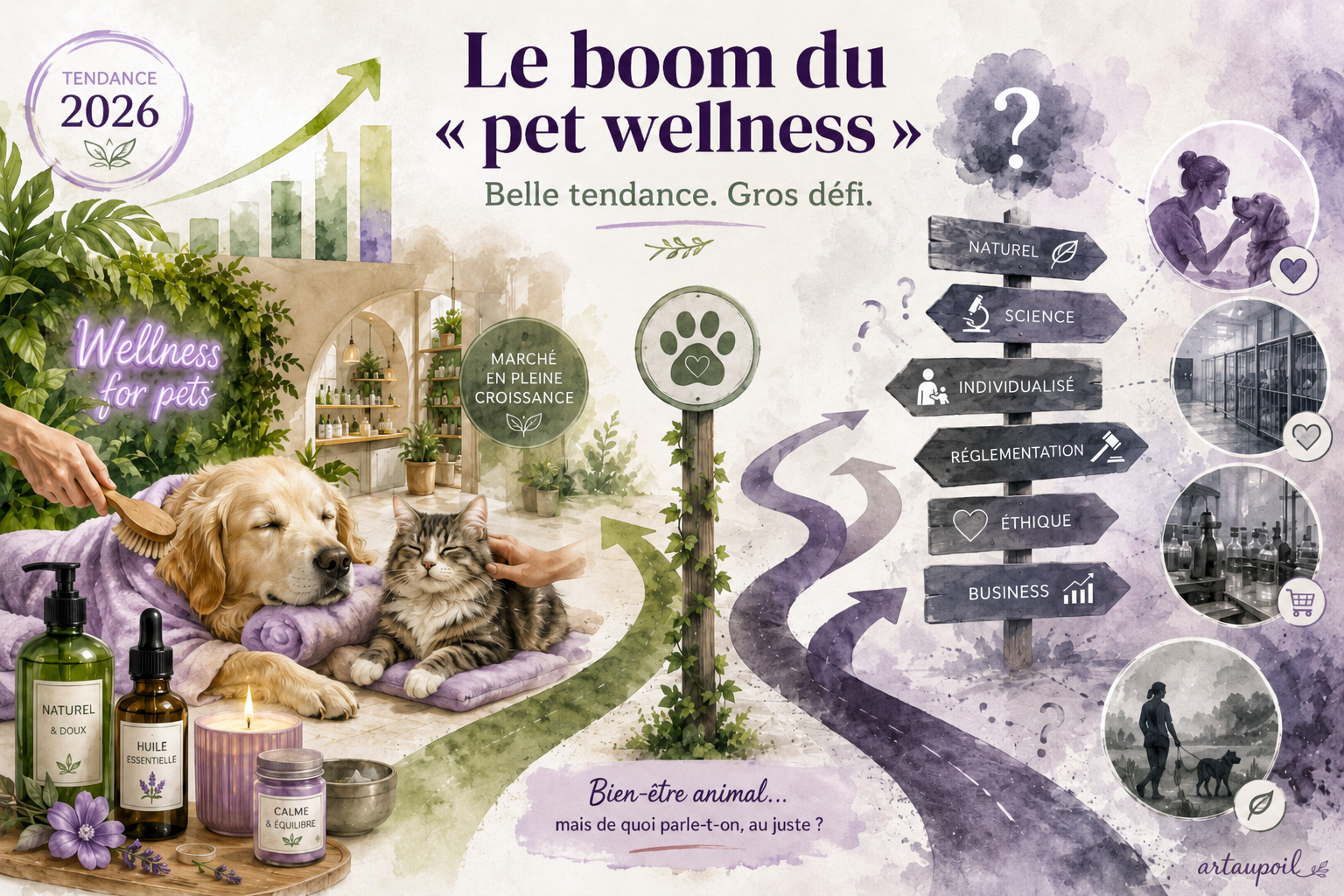
In 2026, the pet wellness market is booming. Gentle grooming, holistic care, pet spas — they’re popping up everywhere. It’s real, it’s legitimate, and in my opinion, it’s good news.
The problem? The term animal welfare is being used as if everyone agreed on what it actually means.
Spoiler: we don’t.
Depending on who is using it, the term can cover completely different realities — sometimes even realities that are total opposites.
What Research Really Tells Us
David Fraser, one of the most respected researchers in this field, identifies three major dimensions of animal welfare:
Physical health — Is the animal healthy? Does the animal have what it needs to function properly?
Emotional states — Is the animal suffering? Is the animal afraid? Does the animal ever genuinely feel well?
Expression of natural behaviours — Can the animal behave like a dog or a cat — not just endure the day?
Animal Welfare: Two Different Realities
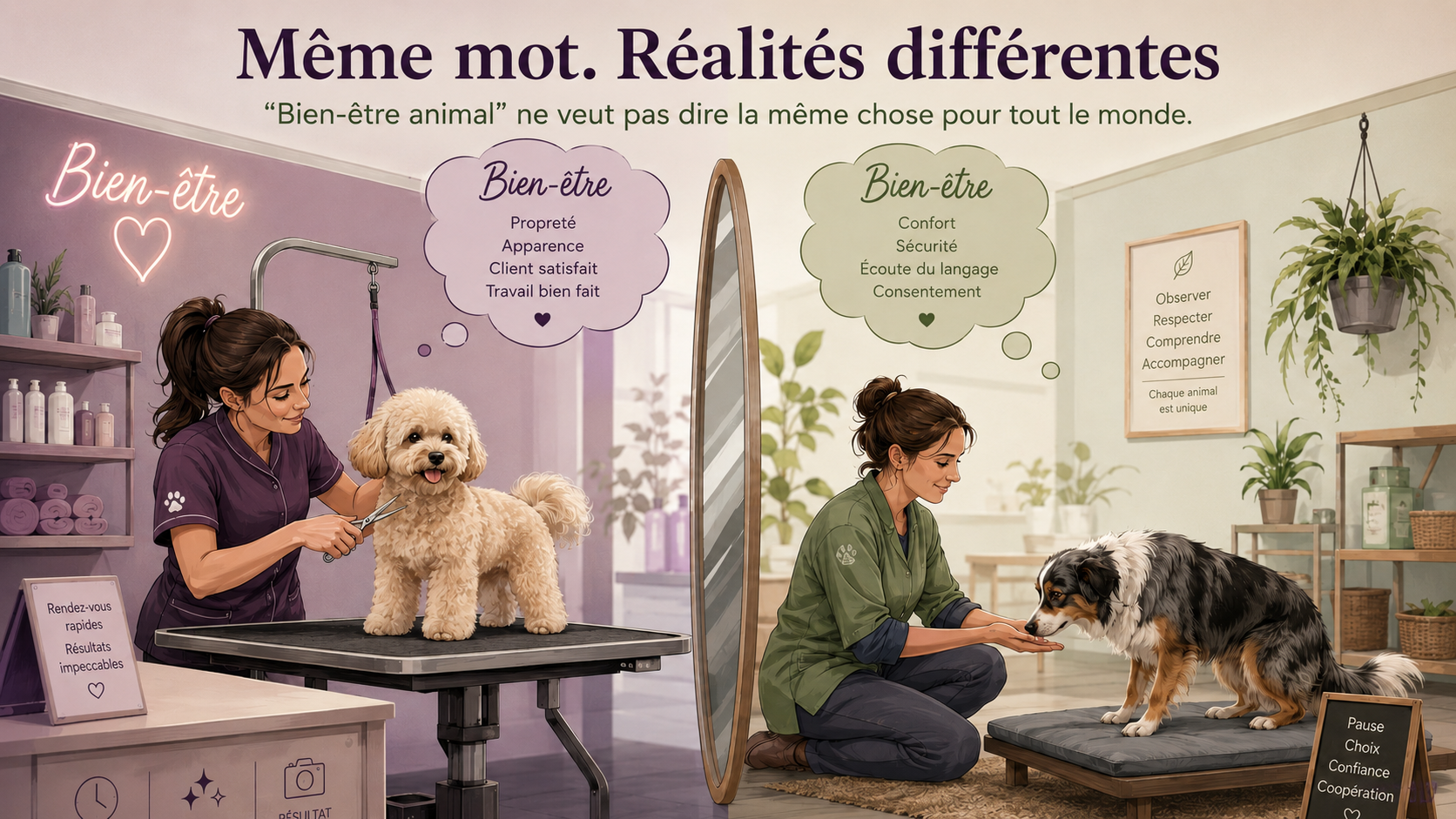
Two groomers can look you straight in the eye and say, “I practise animal welfare,” while working in completely different ways.
It doesn’t necessarily mean one of them is lying.
It means they’re not talking about the same thing at all.
Two Tools to Get Out of the Fog
The good news is that we don’t have to figure this out alone. Two internationally recognized frameworks can help us make sense of it.
The WOAH Definition
The World Organisation for Animal Health defines animal welfare as “the physical and mental state of an animal in relation to the conditions in which it lives and dies.”
Short as it is, that sentence says something fundamental: what the animal feels matters just as much as its physical health.
That is not a minor detail.
The Five Domains Model — Mellor, 2020
This framework evaluates welfare through five dimensions: nutrition, physical environment, health, behavioural interactions, and mental state.
What makes it different from older approaches?
Simply reducing negative experiences is not enough. We must also create opportunities for animals to experience positive states.
It may sound simple, but in everyday grooming practice, it changes everything.
← Swipe left to read the full text on your phone
Key takeaway :
Animal welfare is not a sales argument.
It is a professional approach based on
measurable indicators and choices you
must be able to explain — to your clients,
to your colleagues, and to yourself.
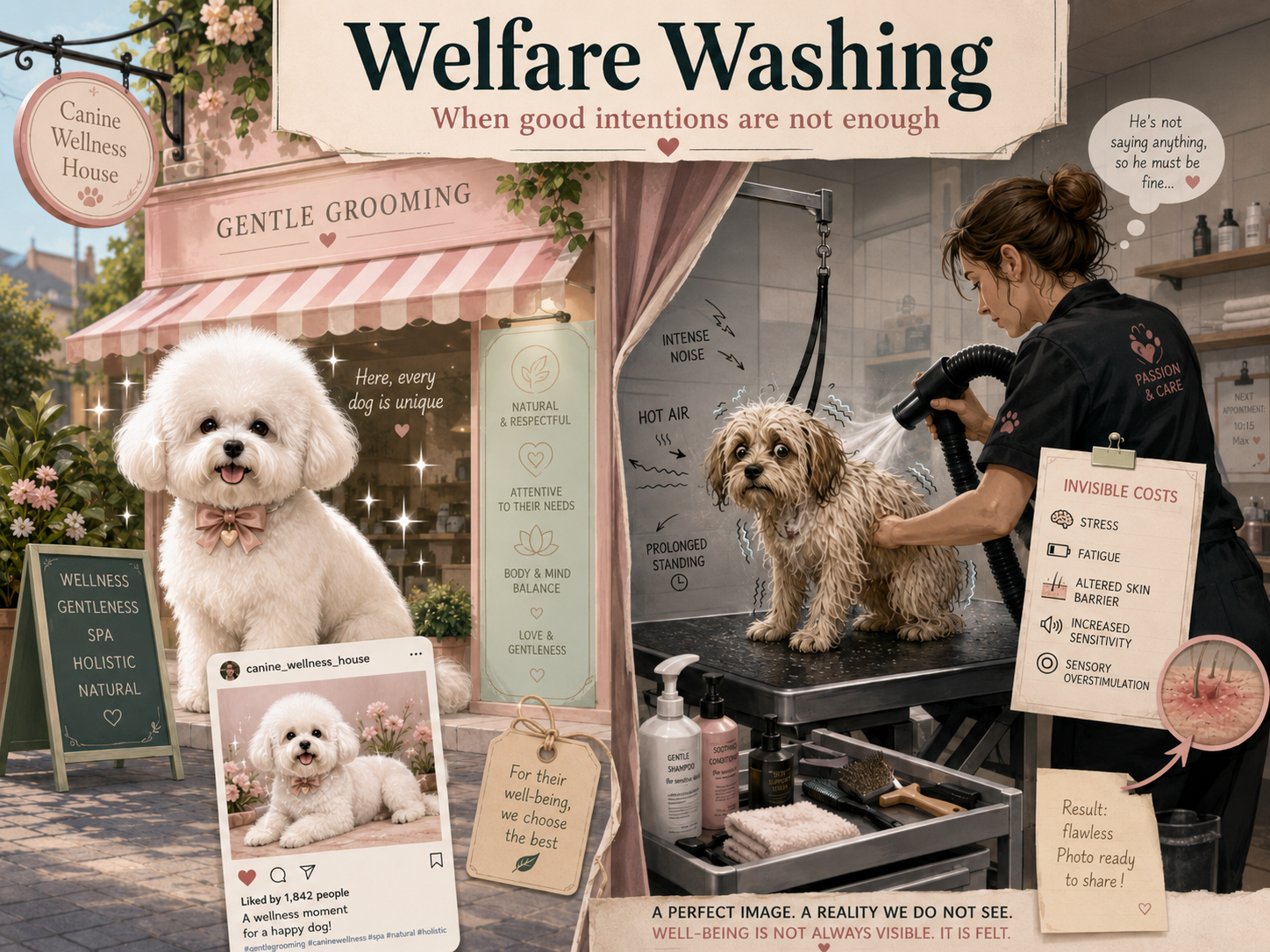
Welfare Washing: When Good Intentions Are Not Enough
You know
greenwashing in environmental marketing?
Welfare washing is exactly the same thing — but in our field.
It is almost never done in bad faith. Most of the time, it’s simply what happens when a concept becomes popular: the more people talk about it, the more it risks being used for everything and anything.
In grooming, this drift is especially insidious.
Why?
Because the
aesthetic result is immediate,
visible, and shareable in two clicks.
The
emotional and biological costs, on the other hand, are often completely
invisible.
A beautiful photo on Instagram tells us absolutely nothing about the level of stress the animal experienced.
It tells us nothing about the state of the skin barrier after washing and drying.
And it tells us nothing about what really happened during the two hours before that perfect picture was taken.
← Swipe left to read the text on your phone

For professionals :
Scientific frameworks help us document
what cannot be photographed — but still truly matters.
They also protect us professionally by giving us
a rigorous language to justify our choices.


For pet owners :
A groomer who talks about animal welfare
should be able to explain concretely how they assess it.
Pretty photos are nice.
Clear answers to your questions are better.
The Three Dimensions of Welfare in Grooming
A grooming session can be technically perfect, breathtakingly beautiful, and still raise serious welfare concerns.
Because aesthetics respond to our standards as humans.
Welfare, on the other hand, must be measured from the animal’s point of view — not ours.
1. Behaviour: Managing Stress at the Source
Handling and restraint can generate stress, fear, and sometimes outright aggression.
Veterinary medicine has known this for a long time — which is why it developed cat friendly and low stress handling protocols.
Recent studies confirm that restrictive restraint methods lead to far more negative reactions in dogs than less coercive approaches.
A serious behavioural grooming approach should demonstrate:
- A measurable reduction in stress signals over time
- Fewer avoidance behaviours
- Progress toward voluntary participation from the animal
- The use of cooperative care techniques/TCAP care
The goal is to teach the animal to participate — not simply to endure. That takes time, training, expertise, and sometimes the willingness to accept that a session will not end the way we had planned.
That is the real work.2. Biology: Coat Is Much More Than Aesthetics
Canine genetics has taught us that different coat types are governed by very specific genes. A Poodle, a wire-haired Terrier, and a Husky should not be treated the same way at all — even if the final result may look similar to the client’s eye.
We tend to talk about coat as if it were just a layer of protection.
But it is much more than that.
Coat Is a Living Organ — and a Sensory Engine
Coat is an organ.
A real, living organ that fulfills several vital functions at the same time:
- Thermoregulation against both cold and heat
- Protection against UV rays and parasites
- Skin barrier support against irritants and pollution
- Social communication between animals and with humans
But it is also a true
biological sensory engine.
It is filled with
mechanoreceptors that help the animal adapt to its environment — structures that inform the nervous system in real time about everything happening around the animal.
Among these structures, we find:
- Tylotrich hairs, which are sensitive to the slightest vibrations and air movements. They are tactile sensors of a precision we can barely imagine.
- Blood sinus hairs — vibrissae, which are highly developed and richly innervated. They support spatial perception, navigation, and distance assessment. This is how the animal reads its world.
In other words: cutting, shaving, carding, or hand-stripping is never a neutral act.
Grooming Means Biological Intervention
Let’s be honest for a moment: every action we take carries a biological cost for the animal.
We need to be able to look ourselves in the mirror and admit that.
- Washing a dog, even with the gentlest products on the market, alters the skin microbiome. That is not an opinion. It is a scientific fact.
- Shaving a dog completely, regardless of breed, makes the animal more vulnerable to its environment — UV rays, irritants, temperature variations, all of it.
- Carding a dense-coated dog at a time when the animal still needs its undercoat for thermoregulation can put the animal in serious difficulty. The body then has to activate biological survival mechanisms designed to prevent heat loss — mechanisms meant for extreme situations, not for a Tuesday afternoon visit to the groomer.
That does not mean we stop grooming.
It means we know what we are doing, we choose the right time, the right technique, and we take full responsibility for our decisions.
That is what being a professional means.
3. Global Health: Reading What the Coat Is Telling Us
Skin and coat are golden indicators of general health.
International guidelines, including WSAVA and AAHA, strongly emphasize the importance of individualized nutritional assessment — because what the animal eats directly influences skin condition and coat quality.
That is not a detail.
A responsible groomer does not promise to “fix” a coat without asking questions:
- What care would be most appropriate for the current season?
- Has the coat changed since the last appointment?
- Are parasites involved?
- Is there physical discomfort?
- Are there dermatological concerns?
In these cases, our role is clear: inform the client and refer them to a veterinarian.
Not
camouflage the problem under a pretty haircut to please ourselves or everyone else.
Because “everyone else” can mean:
The client who wants a beautiful dog for the photo
The groomer who wants to feel they did a good job
The professional ego that enjoys delivering beautiful work
Our job is not to hide.
Our job is to help.
📋 A Concrete Case That Says More Than a Thousand Words
Last week, one of my students in France — certified in zoocosmetology ZAP 1 and ZAP 2 with Art au Poil — sent me the file of two dogs from the same family who had been struggling for months.
Both dogs were clearly suffering:
- Constant itching
- Chronic nervousness
- Alopecia
- Inflammation all over the body
Both dogs had seen a veterinarian.
Both had received different diagnoses, repeated corticosteroid prescriptions, and supplements suggested here and there — with no results.
The family was at the end of their rope.
Using her completed ZAP health questionnaire — a tool we teach in the certification — my student structured her observations and shared the full picture with me.
After reading it, I suggested a very targeted approach: return to the veterinarian and request a skin scraping to assess for specific parasites — sarcoptic mange, demodex — or secondary infections such as yeast or bacteria.
That is exactly what they did.
The diagnosis came back: sarcoptic mange.
Two dogs, two exhausted humans, months of avoidable suffering — because one single investigative path had been missing.
Today, these two dogs can finally regain peace of mind after a long and painful journey without answers.
What this story tells us
A trained groomer — truly trained — never replaces the veterinarian.
But their clinical eye, structured questionnaire, and observational skills can open investigative paths that no one else had thought to explore.
That is real interprofessional work.
Not just grooming.
Shared care.
Why Sarcoptic Mange Is So Often Missed
This case is not an accident.
Sarcoptic mange — Sarcoptes scabiei var. canis — is difficult to diagnose, which explains why so many dogs suffer from it for months before it is finally identified.
Here is what you need to know:
The mites live in the deeper layers of the epidermis. They are microscopic, mobile, and they hide.
Skin scraping has a detection rate of only 30 to 50%.
In other words, a negative scraping does not rule out mange.
It is often necessary to repeat several scrapings on different areas to confirm it.
The symptoms resemble many other conditions: allergies, dermatitis, fungal infections.
Without a targeted suspicion, the veterinarian may explore several hypotheses before reaching the correct one.
It is highly contagious between animals, which explains why both dogs in the same household were affected.
This is exactly why persistence in the diagnostic process is crucial.
And it is exactly why a trained groomer, using a structured questionnaire, can make such a difference: they can suggest the right path to investigate.
Sources: Mueller & Bensignor, 2018 — Veterinary Dermatology Manual; ESCCAP Guidelines, 2023; Veterinary Clinics of North America: Small Animal Practice — Bourguignon et al., 2013.P.S. — Do You Want to Be Able to Help Like This Too?
If this story moved you, this is exactly what we teach in the ZAP certification:
Observe. Structure. Question. Refer.
Not to replace the veterinarian — never.
But to become an essential link in the animal’s care chain.
The ZAP health questionnaire is not just a form.
It is a proven clinical tool that allows a groomer to notice what others may miss.
The ZAP 1 + ZAP 2 Certification Trains Professionals To:
Perform a structured skin evaluation before every grooming session
Understand the mechanisms of the skin barrier, microbiome, and coat functions
Formulate their own natural cosmetics adapted to each skin and coat type
Become a credible partner for veterinarians and pet owners
Take ZAP 1 on demand — 1 full year of access:
I want access to ZAP Module 1 for one full year:
https://artaupoil.com/fr/formation-disp.asp?i=11The next practical ZAP 2 module — Formulation of Natural Cosmetics for Animals — will take place on June 14, 15, and 16 in Quebec.
Only 3 places available.
Individual creation stations.
Reserve my ZAP 2 lab station:
https://artaupoil.com/fr/formation-disp.asp?i=173
Every groomer trained in ZAP potentially means animals will suffer less, for less time, in silence.
That is the real impact of deep training.
Guide pratique : évaluer et améliorer vos pratiques
Pour les toiletteurs et les écolesLe modèle des Cinq Domaines, c'est une grille d'évaluation continue — pas juste après coup. En TCAP, on se pose ces questions-là avant la séance, pendant chaque étape, pis après. C'est ce qui nous permet d'ajuster en temps réel, avant qu'une bascule neurochimique se produise.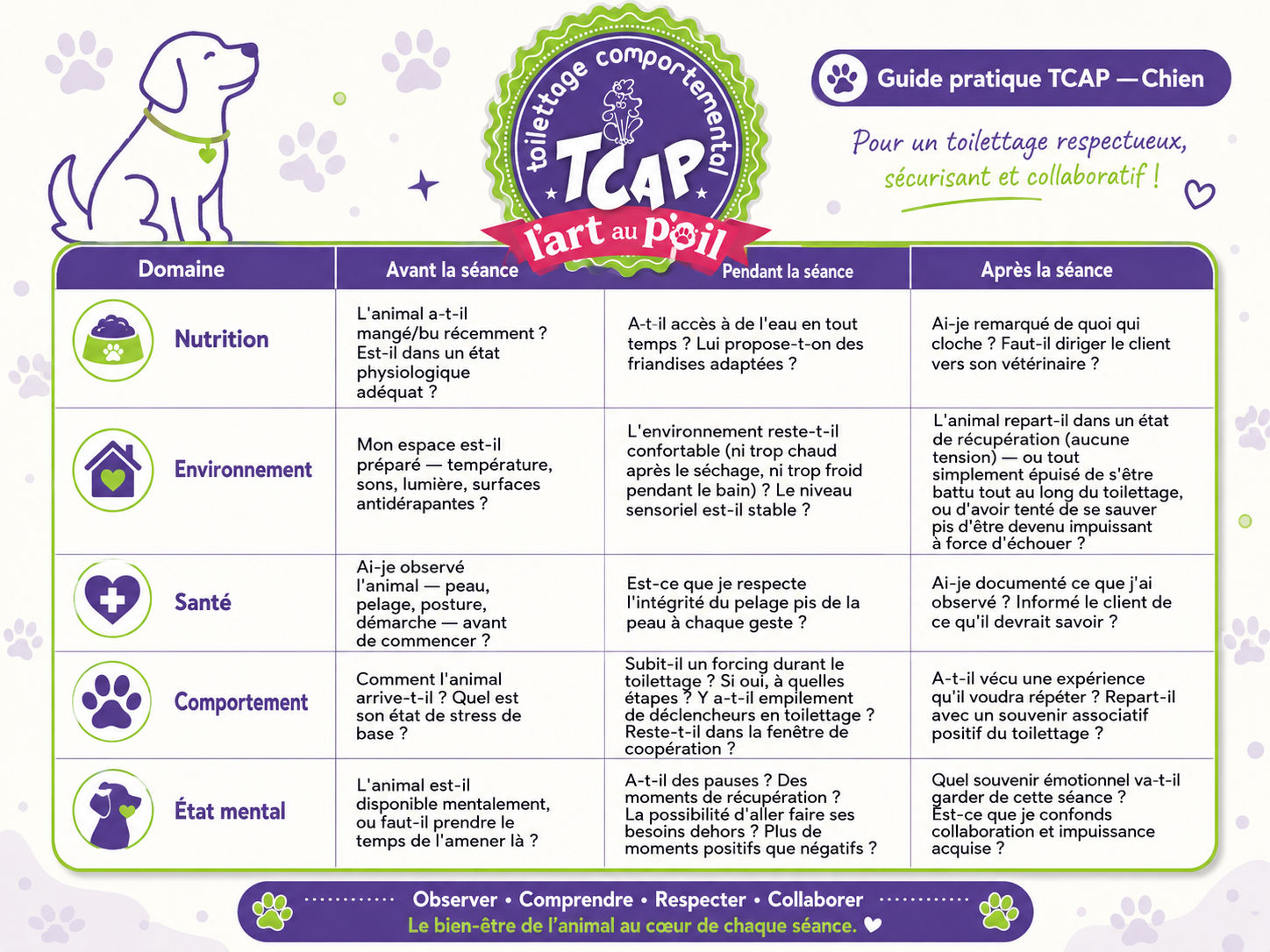
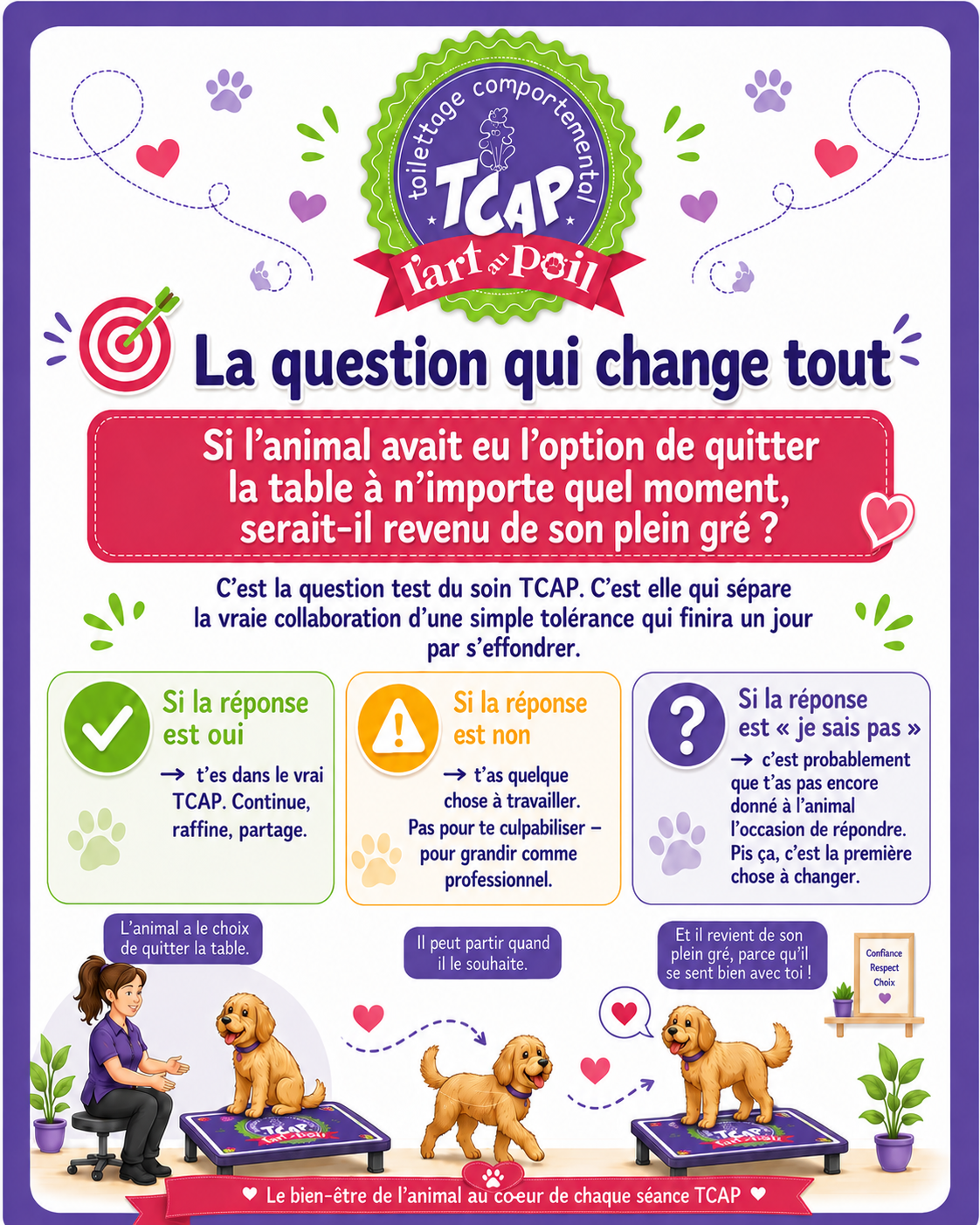
La question TEST qui change TOUT :
🟣 Principe TCAP fondamental :
En toilettage comportemental TCAP, le stress aigu n'est jamais acceptable.
C'est pas une cible à minimiser — c'est un seuil qu'on franchit pas.
Notre travail commence en amont : créer les conditions neurochimiques
de l'ocytocine + dopamine + endorphines avant même que la séance commence,
pis les maintenir tout au long.
C'est ça, le vrai soin TCAP. C'est pas une question d'avoir un animal « bien dressé » qui endure. C'est une question de respecter sa neurochimie pour qu'il puisse, séance après séance, participer de son plein gré.
🚨 Les trois questions qu'aucun toiletteur n'ose se poser
Voici les 3 questions qui séparent un vrai professionnel du bien-être d'un toiletteur qui croit faire du bien-être :
1. Subit-il un forcing durant le toilettage ? Si oui, à quelles étapes ?
Le forcing, c'est rarement total — c'est souvent localisé à des moments précis : les oreilles, les pattes, le séchage, la coupe des ongles, l'épilation, le nœud sous la queue.Si tu peux pas répondre étape par étape, c'est que tu observes pas assez finement. Pis si tu fais du forcing à une seule étape, c'est cette étape-là qui va contaminer tout le reste de la séance dans la mémoire de l'animal.2. Repart-il dans un état de récupération (aucune tension) — ou tout simplement épuisé ?
Là, faut être honnête deux minutes. Un animal qui repart « calme », est-ce qu'il est vraiment détendu, ou est-ce qu'il est juste épuisé d'avoir tenté de se sauver tout au long du toilettage, sans succès ?Voici la séquence qu'on observe trop souvent :
- L'animal tente de se battre ou de se sauver → activation du système sympathique
- Ses tentatives échouent à répétition → épuisement adrénergique
- Il arrête d'essayer → bascule en shutdown
- Il devient « facile » → mais c'est pas du calme, c'est de l'effondrement
Un animal en vrai état de récupération, c'est : aucune tension musculaire, respiration profonde, regard doux, parasympathique dominant, endorphines actives.Un animal épuisé, c'est : tonus résiduel, regard vide ou fixe, respiration superficielle ou hyper-relâchée, système nerveux vidé.Sur une photo Instagram, ça se ressemble. Dans le corps de l'animal, c'est l'opposé.3. Est-ce que je confonds collaboration et impuissance acquise ?
L'impuissance acquise (Seligman, 1967), c'est l'état d'un animal qui a appris qu'il peut rien faire pour changer ce qui lui arrive. Il arrête de résister. Il devient « facile à toiletter ». Sauf que ça, c'est pas de la coopération. C'est de la résignation neurobiologique. Le toiletteur voit un animal docile. La science voit un animal qui a abandonné.L'animal apprend pas à être impuissant tout seul. Il l'apprend avec quelqu'un. Pis ce quelqu'un, ben souvent, c'est nous — pas par méchanceté, par méconnaissance.Mais voici la bonne nouvelle : ce qui s'apprend peut aussi se désapprendre. Pis c'est exactement là que commence le vrai travail TCAP — créer les conditions pour que l'animal réapprenne à coopérer librement.La vraie collaboration, c'est un animal qui pourrait dire non — et qui choisit de dire oui.
🧠 La cascade neurochimique du stress aigu : pourquoi le TCAP refuse de l'enclencher
Une grille d'évaluation, c'est utile. Mais en TCAP, on se contente pas d'évaluer après coup — on travaille pour empêcher la bascule neurochimique de se produire. Pis pour ça, faut comprendre ce qui se passe dans le corps de l'animal.Une fois que le stress aigu est déclenché, son organisme bascule dans une cascade neurochimique qui prend des heures, parfois des jours, à se réguler. Concrètement, voilà ce qui se passe :
- Activation de l'axe HPA (hypothalamo-hypophyso-surrénalien) → libération de cortisol
- Décharge d'adrénaline et de noradrénaline par le système nerveux sympathique
- Inhibition de l'ocytocine, de la dopamine pis des endorphines — le trio hormonal qu'on recherche en TCAP
- Réduction de la sérotonine disponible comme neuromodulateur
- Mémorisation émotionnelle négative par l'amygdale — un apprentissage durable de la peur qui va resurgir à la prochaine séance
Autrement dit : dès que l'animal entre en stress aigu, la séance est compromise sur le plan neurochimique. On peut pas « rattraper » avec des friandises ou des pauses. Le système est déjà engagé dans une cascade qu'on peut pas inverser sur place.Ce qu'on observe en continu, en TCAP :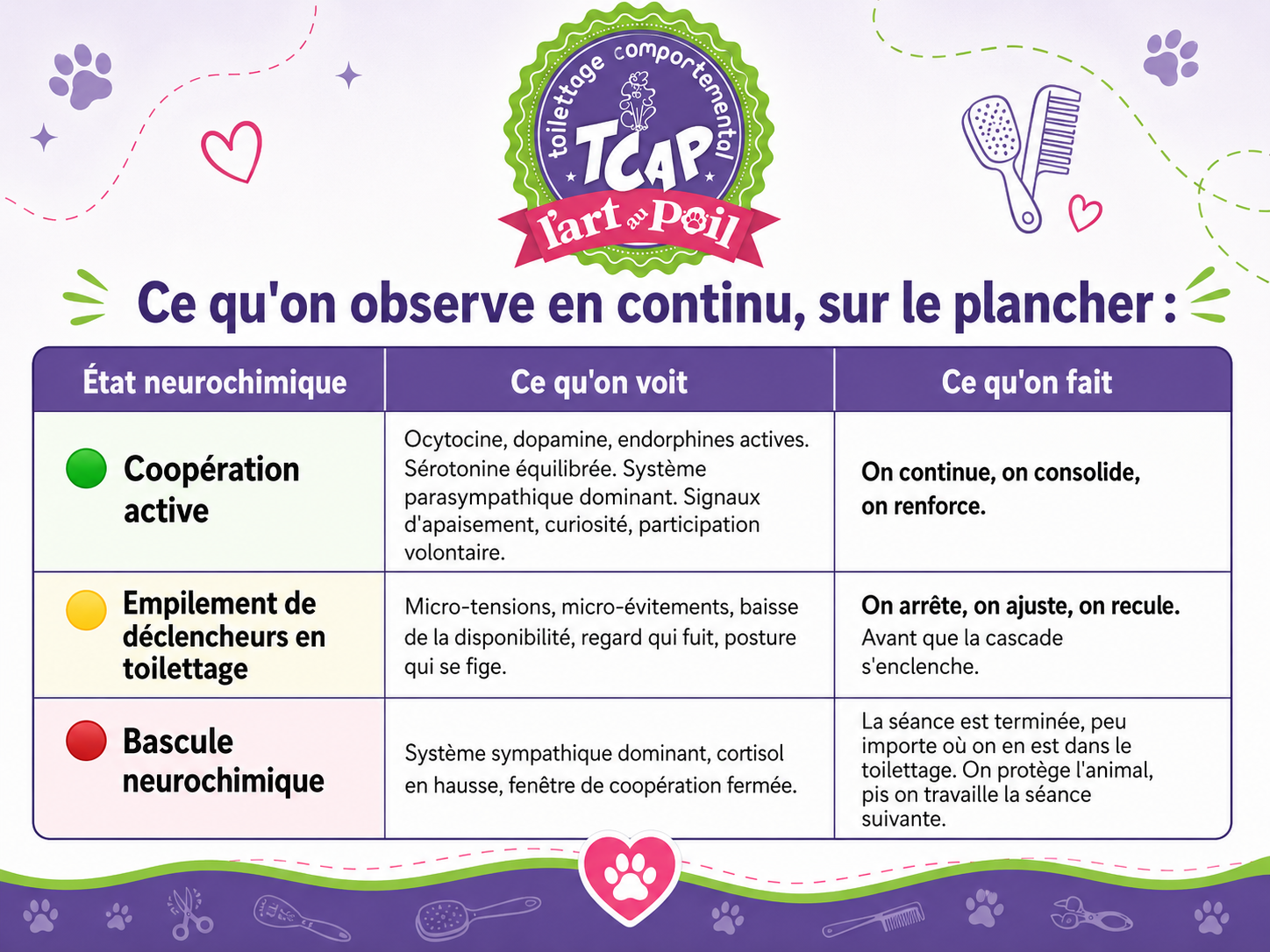
Des programmes comme Fear Free Grooming, Low Stress Handling ou TCAP
offrent des formations reconnues avec des critères d'évaluation clairs.
Ces certifications-là, elles garantissent pas la perfection
— aucune le fait, faut s'entendre.
Mais elles montrent un engagement réel envers l'amélioration continue.
Pis ça, ça compte gros.
Pour les propriétaires : ce que vous avez le droit de demander
Écoutez ben : vous avez tout à fait le droit de poser des questions sur les pratiques de votre toiletteur. Votre chien ou votre chat passe parfois deux, trois heures tout seul avec quelqu'un — c'est tout à fait normal de vouloir savoir ce qui se passe pour vrai derrière les portes du salon.Voici cinq questions qui en disent long :1. « Comment vous gérez le stress pis la peur durant le toilettage ? »Ce qu'on veut entendre : des pauses, du renforcement positif, de l'observation du langage corporel, du respect du rythme de l'animal. Si la réponse, c'est « ben les chiens, ils s'habituent », c'est un drapeau jaune.2. « C'est quoi votre approche pour les chiens à double pelage ? »Ce qu'on veut entendre : une réponse nuancée qui reconnaît les risques du rasage pis qui propose des alternatives concrètes. Si on vous dit « ben je le rase, c'est plus facile à entretenir » — drapeau rouge direct.3. « Quelle formation vous avez en bien-être animal ? »
Ce qu'on veut entendre : des certifications reconnues, de la formation continue, la capacité à nommer des protocoles précis (TCAP, Fear Free, Low Stress Handling). Pas juste « j'aime les animaux » ou « ça fait 20 ans que je toilette ». Tout le monde aime les animaux. Pis 20 ans de toilettage sans formation continue, ça peut être 20 ans des mêmes erreurs.4. « Qu'est-ce qui se passe si mon chien devient trop stressé durant la séance ? »
Ce qu'on veut entendre : un protocole clair — arrêt de la séance, séances plus courtes pis fractionnées, référence à un professionnel du comportement si ça revient. Si on vous dit « je le maîtrise pis je finis la job » — c'est un drapeau rouge majeur.5. « Pouvez-vous me donner des exemples concrets où vous avez mis le bien-être de l'animal en avant, même si ça affectait le résultat esthétique ? »
Ça, c'est la question-piège — pas piège méchamment, piège révélatrice. Un vrai professionnel du bien-être a des exemples qui sortent tout seuls, sans chercher ses mots. S'il hésite, s'il bafouille, s'il généralise avec des « ben oui oui je fais attention » sans donner de cas précis... c'est qu'il y en a probablement pas tant que ça dans sa pratique.
Ce qu'on doit bâtir ensemble
Le bien-être animal est devenu un enjeu central dans notre industrie, et tant qu'à moi, c'est une bonne nouvelle. Mais notre responsabilité collective — professionnels, formateurs, clients — c'est de faire en sorte que cette tendance se traduise par des changements réels et mesurables. Pas juste par de belles publications Instagram pis des hashtags #welfare.Pour y arriver, on doit :
- Utiliser un langage commun, ancré dans des cadres scientifiques reconnus (WOAH, Cinq Domaines, TCAP)
- Documenter nos pratiques avec des indicateurs observables — pas juste des impressions
- Assumer nos choix professionnels de façon transparente, devant nos clients pis nos collègues
- Investir dans la formation continue — pour vrai, pas juste sur papier pour décorer notre site web
- Accepter que le bien-être puisse parfois bousculer nos ambitions esthétiques, pis que ça, c'est correct
C'est comme ça qu'on passe d'un bien-être de vitrine à un bien-être authentique. Celui qui change vraiment quelque chose pour les animaux dont on a la responsabilité.Pis honnêtement ? C'est aussi celui qui rend notre métier plus beau, plus solide, pis plus épanouissant à pratiquer.Références : Organisation mondiale de la santé animale (WOAH) ; AVMA ; Fraser, 2008 ; Mellor, 2020 (modèle des Cinq Domaines) ; AAFP/ISFM ; WSAVA ; AAHA ; Cisneros, 2025 ; Nakonechny, 2025 ; Cadieu, 2009 ; études sur le photopériodisme et la mue canine.